

MES for Injection Molding
The demands on modern injection molding production are constantly rising. Energy costs, quality requirements, and global competitive pressure are forcing companies to make their processes more efficient, transparent, and stable.
Many production facilities already have access to vast amounts of machine data, but it is often scattered across controllers, Excel files, or isolated systems. This is exactly where a modern Manufacturing Execution System (MES) comes in.
With the MES-PiSolutions platform, bfa has been helping companies digitize production processes, intelligently network machines, and turn manufacturing data into actionable insights for over 40 years. The goal: greater transparency, fewer downtimes, and measurably higher production efficiency.
What is an MES?
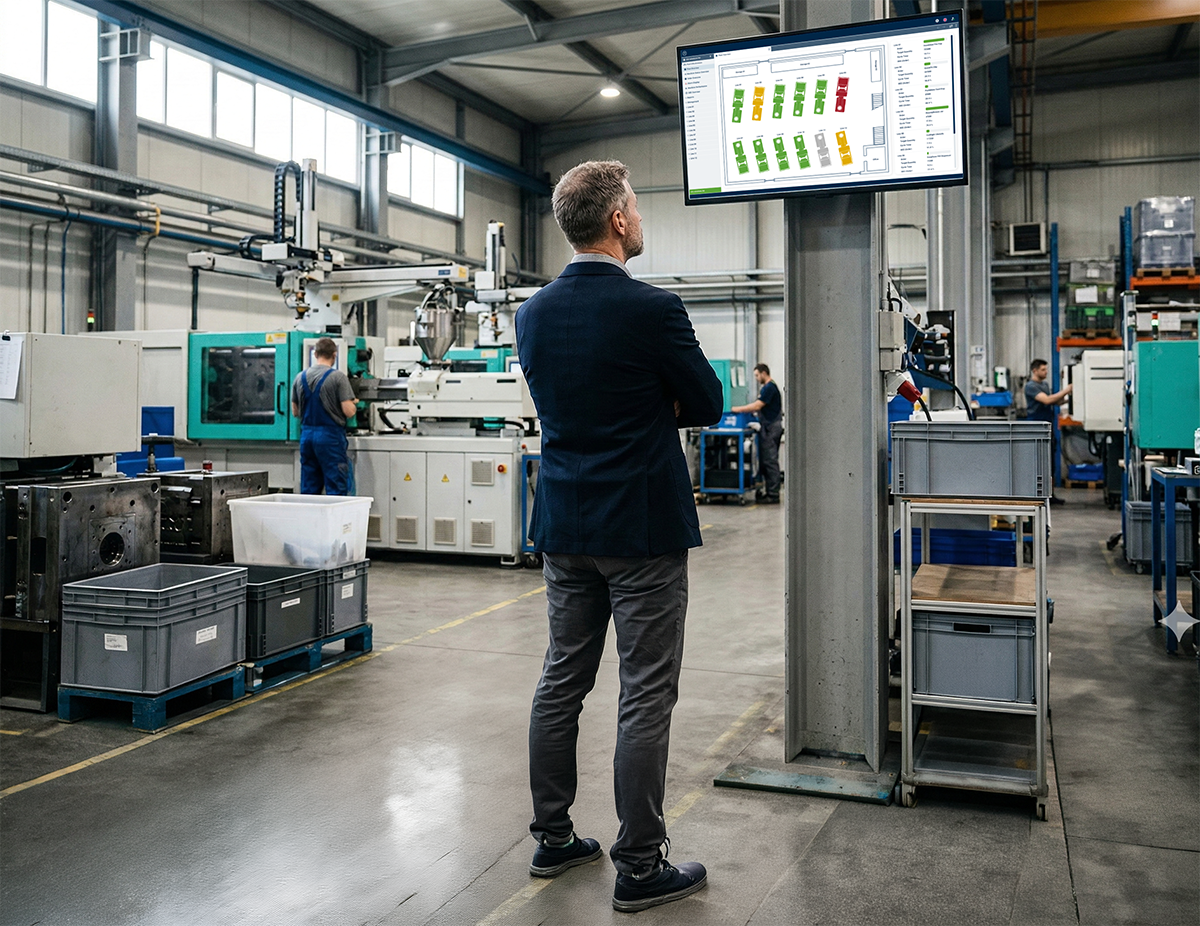
A Manufacturing Execution System (MES) is the central software layer between the shop floor and the ERP system.
While ERP systems primarily handle planning and order management, an MES ensures that actual production becomes visible, controllable, and traceable in real time.
An MES connects:
- Machines and production facilities
- Production and quality data
- Order information
- Operator input
- ERP and quality systems
into a comprehensive digital representation of manufacturing.
Injection molding, in particular, generates vast amounts of data that can scarcely be utilized efficiently without intelligent data acquisition and analysis.
Typical challenges in injection molding
Many companies face similar challenges in their day-to-day production.
Lack of transparency on the shop floor
While production data exists, it is often not systematically analyzed.
Typical situations:
- OEE analyses are performed manually in Excel
- Shift reports are created manually
- Causes of downtimes remain unclear
- Production metrics are not available in real-time
The result: Decisions are often based on assumptions instead of reliable data.
High scrap rates
Even small process deviations in injection molding can lead to quality problems.
Common causes:
- Temperature fluctuations
- Material issues
- Tool wear
- Unstable process parameters
Without continuous data analysis, deviations are often only detected after scrap has already been produced.
Hidden machine downtimes
Many production losses remain invisible in daily operations:
- short machine stops
- material changes
- setup processes
- organizational delays
Only systematic data collection reveals where productivity is actually lost.
Increasing requirements for quality and traceability
Today, customers demand:
- complete traceability
- documented production parameters
- fast complaint analysis
- complete quality documentation
Especially in regulated industries, this quickly becomes very resource-intensive without digital support.
What functions does an MES perform in injection molding?
An MES provides transparency across the entire production and enables data-driven decisions in real time.
With the MES-PiSolutions platform, bfa takes a modular approach. Companies can start with the BASIC Bundle and later expand the solution with targeted add-ons.
The MES PiSolutions BASIC Bundle
The BASIC Bundle provides the foundation for transparent and data-driven production in injection molding.
It combines the key functions for:
- Real-time machine monitoring
- OEE analysis
- Alarm and downtime management
- Reporting and production analysis
- Scrap and defect classification
As a result, companies immediately gain greater transparency into machine statuses, production performance, and quality losses.
Especially in injection molding, the BASIC Bundle helps to:
- Detect downtimes faster
- Sustainably reduce scrap
- Make processes more stable
- Make production data centrally available
- Make decisions based on real-time data
A major advantage: The system can be introduced gradually and expanded flexibly.
Real-time Production Monitoring
The platform can be modularly expanded – tailored to production requirements.
Production
Management of production orders, machine assignments, and process control directly within the system.
Process Data
Automatic capture of target and actual data for each machine cycle.
Recipe
Management and transfer of machine data records with full traceability.
Connector
Automatic data exchange between MES, ERP, and quality systems.
GMP
Support for regulated production environments in accordance with GAMP 5.
Maintenance
Centralized planning and management of maintenance tasks to increase asset availability.
Assets
Centralized management of assets, inventory, and documentation.
Energy
Analysis of energy consumption, costs, and CO₂ emissions.
Customized
Bespoke extensions and functions, tailored to your specific production processes.
Real-time production monitoring
The MES-PiSolutions platform connects with injection molding machines and peripheral equipment from a wide range of manufacturers.
Continuously collected data includes:
- Cycle times
- Machine status
- Production quantities
- Downtimes
- Energy consumption
- Quality parameters
All information is visualized in real-time and made available centrally.
This provides production managers with a complete overview of the current state of production at all times.
Real-time OEE analysis
Overall Equipment Effectiveness (OEE) is one of the most important key performance indicators in production.
An MES automatically calculates:
- Availability
- Performance
- Quality Rate
This reveals:
- which machines operate particularly efficiently
- where downtimes occur
- which processes have optimization potential
With the OEE dashboard from MES PiSolutions, bottlenecks can be identified early and specifically improved.
Quality Monitoring and Full Traceability
An MES automatically and seamlessly documents production and quality data.
This makes it possible:
- to fully trace batches
- to identify process deviations early
- to analyze complaints faster
- to reliably meet regulatory requirements
This transparency is crucial, especially in the medical sector and for demanding plastic applications.
Production Planning and Order Control
In addition to data acquisition, an MES also supports the active control of production.
These include:
- Order releases
- Machine assignments
- Shift planning
- Progress monitoring
- Central management of production information
The result is significantly better alignment between planning and actual production.
When is an MES worthwhile in injection molding?
Not every company immediately needs a fully developed MES.
Typical signs that implementation is worthwhile:
- multiple machines or production lines
- frequent order and/or product changes
- increasing scrap costs
- lack of transparency regarding downtimes
- high effort for quality documentation
- heterogeneous machine fleets
- growing competitive pressure
Especially for companies with many facilities, an MES can often quickly achieve measurable efficiency gains.
What specific benefits does an MES offer?
A well-implemented MES often leads to clearly measurable improvements.
Higher machine utilization
Downtimes become visible and can be specifically reduced.
Less scrap
Process deviations are detected early and corrected faster.
Faster decisions
Production managers receive all relevant information in real time.
Improved traceability
Production and quality data remain traceable at all times.
More stable processes
Standardized data and automated analyses ensure greater process reliability.
How is an MES implemented?
Many companies fear that an MES project is very complex. In practice, implementation usually happens in phases.
1. Analysis of production processes
First, existing processes are analyzed:
- Which machines should be connected?
- Which data is relevant?
- What goals should be achieved?
2. Machine integration
Machines are connected via standardized interfaces or gateways.
Even older systems can often be integrated without problems.
3. Software configuration
The MES is adapted to individual requirements.
For example:
- Dashboards
- Reports
- Quality parameters
- User roles
- Alarm management
4. Employee Training
For an MES to be used successfully, acceptance on the shop floor is crucial.
Employees receive targeted training and are integrated into the process.
5. Phased Expansion
Many companies start with a pilot area and later expand the system to additional machines or production lines.
Thanks to the modular design of MES PiSolutions, the system flexibly grows with the requirements.
What should companies look for when choosing an MES?
Several factors are crucial when selecting an MES:
- seamless integration with existing machinery
- scalability for future growth
- intuitive operation
- stable data architecture
- industry-specific features
- long-term support and maintenance
Crucially, the system must not only be technically impressive but also align with the company's actual processes.
Why bfa?
For over four decades, bfa has been developing end-to-end automation solutions for industry – from machine control to ERP connectivity.
With the MES-PiSolutions platform, bfa offers a modular solution for production monitoring, OEE analyses, traceability, and manufacturing digitalization.
Companies in the injection molding sector particularly benefit from:
- vendor-agnostic machine connectivity
- industry-specific solutions like PiInject
- end-to-end integration from shop floor to ERP
- modular expandability
- a single point of contact for software, integration, and automation
Conclusion: MES as the foundation of digital production
Injection molding is one of the most data-intensive manufacturing processes in the industry.
Companies that strategically utilize this data lay the groundwork for more efficient processes, higher quality, and increased competitiveness.
A modern MES connects machines, data, and processes into a transparent overall system – enabling data-driven decisions in real time.
For many injection molding companies, an MES is therefore a central building block on the path to digital production.
Next Step
Would you like to discover the full potential of your production?
Talk to our experts about your requirements and discover how MES PiSolutions can make your manufacturing more transparent, stable, and efficient.
